
How Kea AI’s paid media channel grew from zero to $435,000 in projected ARR within 90 days.
Artificial intelligence and customer service technology
Track performance accurately, test ideas thoroughly
Paid media channel grew from zero to $435,000 in projected ARR within 90 days
The Voice AI that helps restaurants never miss a call.
Kea is an AI phone ordering system built specifically for restaurants.
It answers calls, takes orders, responds to customer questions, and sends orders directly to the restaurant’s point-of-sale system.
This gives restaurant teams an extra set of hands during busy periods, helping them capture more orders without adding more pressure to their staff.
Kea has the strongest product in the market, built on eight years of experience in the restaurant industry.
But they had seen no results from paid acquisition in recent months.
They knew paid media could be an amazing channel for them.
They just needed a framework that could help them scale fast.

“The problem for us was that we were moving in a direction, but we were kind of moving blind.
It was like driving on a highway. We obviously kind of knew where we were in the space of this desert of word ads, but we didn’t know how to make the right turns as quickly as possible.
If we hadn’t had Plínio, we probably would have spent six to nine months getting towards success when we actually did that within six to nine days.”
Max Tilka, Senior Product Manage, Kea
Many companies believe they need a large advertising budget before they can learn anything meaningful.
We took a different approach.
We applied an MVP mindset to paid media.
Instead of building a complex strategy and committing thousands of dollars before validating our assumptions, we identified the smallest experiment that could give Kea a clear signal that paid media deserved more investment.
We got results within the first week and then scaled the channel.
Validation was only the beginning.
We used every campaign to answer a specific question:
- Which benefit resonated most?
- Which ad format performs best?
- Which headline is most effective at stopping the scroll?
- Which landing page converted more effectively?
- Which ads could support a larger budget?
We talked daily, met weekly, and made decisions as soon as the data was clear.
Weak campaigns were stopped quickly.
Promising ideas received new variations.
New landing pages were tested in parallel with the existing campaigns.
Instead of waiting weeks for one large campaign to produce an answer, Kea could run several focused experiments during the same period.
After 90 days working with Bottleneck Marketing, Kea:
- Optimized its tracking, giving the team more accurate visibility into performance.
- Found scalable winners, enabling the company to grow profitably.
- Implemented a testing routine, helping the team make smarter decisions faster.
- Monitored competitors, allowing the team to create ads that stand out.
As a result, in just 90 days:
- Kea’s paid media channel grew from zero to $435,000 in projected ARR.
- The company achieved a mind-blowing ROAS of 29.2.
Kea built the foundation to scale paid media with confidence.
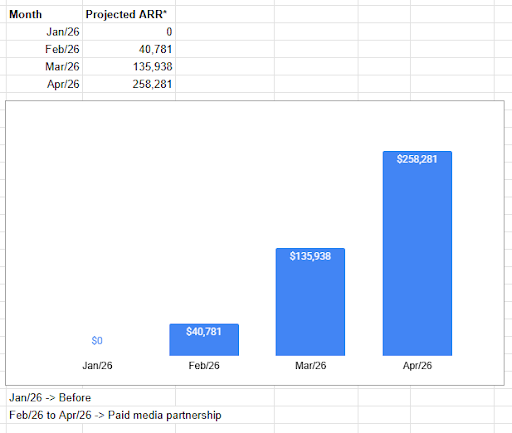
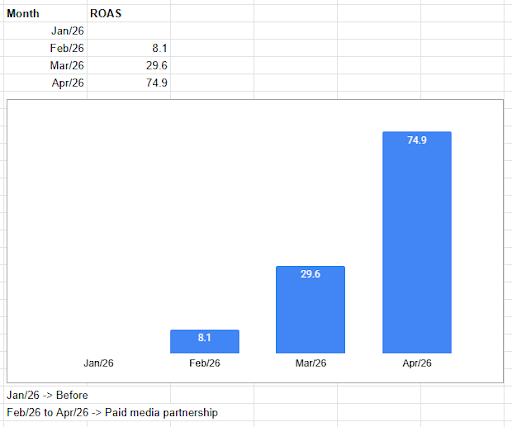
graph information
*Projected ARR means Projected Annual Recurring Revenue.
This indicator represents the potential annual recurring revenue associated with qualified leads generated through paid media during each month. Each month is treated as a separate cohort, so the figures are not cumulative and do not represent revenue already realized.
ROAS means Return on Ad Spend.
Formula is below:
ROAS = Projected ARR / (Ad Cost)
Important note:
The partnership started on February 11, 2026. To simplify, each month in the graph starts on the 11th and ends on the 10th of the following month.
“Plinio is an incredible marketing partner. Transparent, fast, and I love the energy he brings to the table. He was the type of person I could immediately trust on Day 1 when working together.
I also loved his passion and pushback on ideas, grounded in data-driven knowledge and industry feedback. I have run many marketing campaigns with teams, and I have never produced as much as I did with Plinio. His lessons have changed my approach to GTM at scale.
We used his services through his company, Bottleneck Marketing, to help Kea AI’s paid media channel grow from zero to $435k in projected ARR within 90 days. That is in ARR towards high-quality leads that showed up for discovery calls.
Was like turning on a money faucet.
And that was aside from the pool of leads, from ads, that we could target with easy email follow-up.
We began with a $500 experiment, generated results within the first week, and then scaled. Over three months, we tested nearly 230 ads across 38 campaigns. So if you want to move fast with purpose, reach out to Plinio.
Past that, he did much more than manage campaigns. They challenged our thinking, improved our tracking, and helped us identify the messages and creative formats that resonated most.
I strongly recommend Plinio and Bottleneck Marketing to companies that want to test and scale paid media effectively and make data-driven decisions, as well as those looking for a fun and enjoyable marketing campaign experience.
Running paid ads doesn’t have to be throwing darts at a board while blindfolded. Plinio has proved you can have a targeted, laser-beam paid-ad marketing machine.”
Max Tilka, Senior Product Manage, Kea
00:00
00:00
I think the more you can fail fast and learning what not to do leads up for success.
00:05
00:05
I think that’s something you very much specialize in, is you really don’t need much to get going to understand what not to do. And the more you learn quickly what not to do, the more you know you’re pushing into that boundary of success, right? I thought something that was like, very valuable is, there’s a lot of marketing people or marketing firms that they either really overcomplicate what’s needed to get started or they make it sound too good to be true.
00:33
00:33
And I think your approach with just how dialed in you are of how simple it was to get started. Things you needed, right? I mean, we walk through the list when thinking about this here. It was, you need six pieces of content, static or video that somebody already had, right? And then you do the rest, and you need a budget of this. And really the actions you have to do with that immediately are, I think, key.
00:56
00:56
So I thought that was something that was really instrumental in having to start with so much success from the get go. Was something like that.
01:17
01:17
a new emerging market for restaurants who are looking to take the stress of phone ordering and questions off their staff and help automating that using voice AI.
01:27
01:27
We got results within the first couple of days, maybe the first day, right, of knowing what to do. And then just because of how how simple you made it.
01:36
01:36
You then showed the iterative process to be very simple to iterate really quickly. Right. So how easy it was to get started reflected with how easy it was to keep moving through it too. Right. It doesn’t it wasn’t like it got harder over time. We had this immediate awesome relationship from the beginning that just, like, compounded as fast as possible, right?
01:57
01:57
So I thought that was really, really cool.
02:00
00:01:27:07
Yeah. I think we can apply the MVP mindset to advertising. You know, I analyze what you have and see, like, what is the minimum change, that I can do, in your business, to validate that hypothesis. Yeah.
02:21
02:21
So, and the good part is that you already have a lot. Yeah. You already have, like, a great landing page, already have great assets. So in your case, I did like, hey, let’s make an experiment about the tags. So that was like an hypothesis. That is going to cost very little.
02:47
02:47
And if it works, we can prove and then we can scale, which was what happened there. Like, we would find, hypotheses with the minimum effort possible, to validate a hypothesis. Once it’s validated, then we started compounding.
03:03
03:03
Yeah. And, yeah, I mean, for things we were missing to test, like, you had amazing resources to bring that in as well, which I really loved, which was building that new landing page.
03:14
03:14
And we ran that in parallel with what we’re currently doing. Right. So really, to me, the style of how you move, as you know, a marketing leader coming to a company is kind of like an engineering team. You’re moving really fast, iterative building quickly, like you’re like, all right, how do we get out the MVP of this?
03:32
03:32
And for the MVP of what’s successful, cool. How do we take it to the next level. Like adding in like the I really love the style. And this is what was refreshing for me is like, that’s how I like to operate too, is how do we compound and build on it over time? Because if we take five weeks to get to when it fails, we spend five weeks when we could have done five iterations like what we did over time.
03:54
03:54
So it’s nice to avoid that. You know, in that case, which I really loved.
04:00
04:00
Yeah. Awesome. Yeah. It’s already like an amazing piece of content that we started. Amazing. Yeah. And the partnership was like amazing, as I told you. Like, what I really love about, Kea. And the thing is, like, when once you have that quality, you take it for granted.
04:23
04:23
But, like, it should be, like, so simple, like people, open to new ideas, open to testing and active listening and acting upon it. That’s, you know, like, yeah, it’s so, so fundamental. And I’ve seen, like, so many people who get over themselves, you know. Thanks for being that support, you know, like believing the things that I was doing and really trying hard, to make it work, working with me, you know?
04:55
04:55
Yeah, I think those things, those things intersect so much for me, right?
05:00
05:00
Because of how you’re jumping into us, it’s. I don’t know if it’s cliche to say, but it’s like, how could I not believe what you’re doing, right? Because you’re so transparent of how you’re going to collect data, how you’re gonna measure upon it with the associated budget, how long it’s going to take.
05:14
05:14
To me, those are all key markers to know. Well, it’s going to show itself at the end if it doesn’t work. And you already had a plan of, well, if we reach failure, that’s good because then we know the next route to take. And it’s not, going back to it, you don’t need $20,000 to start this.
05:33
05:33
Right. So really burning what $500 I’d say. Let’s say you fully burn it, right. What you’re not going to do, you’re going to find if you run this correctly, you gonna find some type of ad within the mix that works. You’re going to find some type of path. So worth it to spend that kind of money in terms of ROI to do it.
05:48
05:48
And this isn’t something for people to know that should take months to ramp up. Right? It’s days. It’s weeks. And so people are bought into that mentality. They should see success right away. And I’m a really big believer of surrounding myself. Like, I know I’ve done paid ads a lot with my life as well as organic, Google ads.
06:08
06:08
I know it. I’m a big believer of surrounding yourself with the smartest experts in that area to learn even more, right? And that’s that was a big part of bringing you in to something like this was you’re a specialist. Even if I know, isn’t it amazing? Let’s say I’m a specialist. Isn’t it great to have someone else near you, if not better to help validate what you’re doing at the same time of this?
06:32
06:32
So that was kind of key for me was to check our assumptions. I think that’s key for anyone kind of watching this. If they’re going into a new emerging market, you need to have a specialist that has maybe seen across emerging markets, continual markets, continual markets that have shifts. You really can’t go into this alone.
06:53
06:53
So you really need someone on your side. And I think that’s the best part about what you bring to the table is specialization, but also the sense of humbleness in terms of finding out new paths. I mean, we were meeting, well, talking daily, meeting weekly. I can’t even remember the number of campaigns we ran, but it felt like we were a team of 50 in how fast we were moving.
07:19
07:19
And we found things I think that that really shaped, what was going on in this space in terms of voice AI for restaurants. Doubling down on, you know, out there there’s a lot of ads that have a lot of fakeness or like money, like we put a sense of realness towards numbers that are actually working with real stories.
07:40
07:40
We didn’t bait people into saying kind of fake metrics. We took what was real, and we made that the focal point. And it was successful. And I liked also, this is weird, but I like that we test different versions of things that we knew would fail to confirm that we weren’t biased in our assumptions. I think that’s key too. You have to you have the test that too.
08:04
08:04
Yeah, the more you test, the more you learn.
08:06
08:06
So explain a little bit about, the value proposition.
08:11
08:11
Yeah, the value proposition, I think, and this comes into why we needed Plínio and something like this is it’s we we know it’s one thing, but it means a lot to budget of restaurants.
08:22
08:22
The value proposition kind of ranges from, you got a low amount of staff. You can’t answer to all the phone calls. You miss phone calls, or staff just doesn’t want to answer the phone at all. So we help take that. There’s a monetary, value as well of, like, even if your staff can’t answer the phone, there’s tons of phone calls coming in.
08:42
08:42
To be able to get every single phone call is kind of important there. For me, it’s all about bringing, kind of controlled chaos in that case. So it’s peace of mind is what we offer in terms of the product. We’re a flat rate, ranging depending on call time from like $450-$350 a month, unlimited calls, unlimited orders, which is really great.
09:07
09:07
So helping people see that value prop and believe that value prop when doing ads is one of the hardest things, right, to trust. A lot of people see AI imagery, don’t believe it’s actually there. Is it even worth it? It’s actually, I know my restaurant. Those are all things you have to communicate in terms of trust to get people to want to buy it.
09:28
09:28
Get people to even want to set a meeting with you to want to buy it. So that was kind of key thing we focused on with you, and we took it by baby steps. Something we kind of diving into, what we struggled with was make sure we have the most accurate tracking.
09:49
09:49
You want every single part of the funnel to revert back to, like, the actual data. What’s coming through. No biases. And I think that’s something that you knocked out of the park within the first couple of days is making sure the right pixels tracking corresponds, because our goal was to get in front of more customers, get more leads, which then turned into more customers.
10:11
10:11
And we blew that through the water, which is which is amazing.
10:14
10:14
The problem was for us was we were we’re moving.
10:17
10:17
We’re moving in a direction, but we’re kind of moving blind.
10:20
10:20
We probably if we didn’t have you, we probably would have spent 6 to 9 months getting towards success when we actually did that within 6 to 9 days.
10:29
10:29
So it’s kind of, it’s a really drastic change to move into this and it was very easy to get my finance team and other stakeholder buy-in just with how cost effective was to start and know where to go. So even if, you know, I always have to evaluate from a mind of like, is this worth it to actually even do.
10:53
10:53
I think of stakeholders that ask that question like, oh, should we actually press restaurants through social media? Will they even be there? Right. You still have to answer that question. You can still you could assume, right. But until you actually do a test, it’s important. And that test doesn’t need to be, you know what, $20,000 to answer that question.
11:14
11:14
That question. I mean, really, that question could actually be, you know, it could be $500. It could be even less than actually, depending on a test, I recommend obviously, putting a little bit of effort into in terms costs, but that was the biggest thing that we were searching for. And through connections, you know, came across your profile.
11:34
11:34
You’re the most kind of that I was impressed with in terms of just pure energy and excitement towards it. Like you want people to be excited towards what they’re doing and specializing. And even if it’s a boring problem, not exciting problem. And what drove me to you was your excitement towards tackling this problem from zero. So we had what we we were getting some people in through leads, very, very minimal.
12:01
12:01
And we kind of we approached it from like a zero null, like non-existent problem. And I really like that. I like even that you could kind of come into an organization, maybe if they’re firing on all cylinders and take it to the next level. So you really do adapt to being a part of the team, which was really key for me.
12:22
12:22
We operate as a really small team doing this to be very successful. And so, all those factors for me, how simple you made it, your dedication and time towards it, it just made an easy decision to say yes and jump right into it.
12:39
12:39
Take me to the moment when you realized my service was actually working to solve your problem.
12:49
12:49
I think it takes me back to… I had this pipeline setup that we notify. I think it was… There’s kind of two answers or two parts to this. One, there’s the aha moment or a really exciting moment when you start an ad and people come through and you see the notification that they had the ad, it’s like, oh, it’s like it’s working.
13:11
13:11
Like people are going through it. You see the whole CPC, campaign, the UTM content, all that stuff, like you see it being tagged, you can see and revert back to what’s actually working. That’s a beautiful moment. And that happened really quickly in the first part of February when we started this on. I think the most impressive moment for me is when we really scale this up.
13:32
13:32
And we took it. I think it was either, I think it was March. We did a lot more spend. We really like not failed together, but we really tested some things to know, not what to do so quickly. And I think that was really key to me of like, we learned really high up what not to do, which then made the corresponding months so successful.
13:54
13:54
So we found out the pipeline worked, but then the opposite. We found out what failed so quickly. And that just gave me so much confidence. What we were doing after that, which was really, really key for me in terms of doing ads, like I felt confident going into a room with my leadership team that I work with and reporting back, being like, we know exactly what not to do, how to get people to show, do this.
14:16
14:16
And then it starts feeling just like levers. These like pull levers, like we weren’t reaching in the dark blindly. Like looking around like we were. We really knew exactly what to pull in when we wanted to pull it. So if we wanted to double spend, we knew. Exactly. All right. Cool. We’ve got we’re going to go from 40 leads a month to 80.
14:32
14:32
Like it’s not like a will it happen? It’s like we know happened. So it’s like do we want to put that spend there. Do you want to do it in a different way? All those things I think are, are kind of key for some of like that.
14:46
14:46
Tell me how we decided to test Meta Ads to see if we’re going to keep working. What was the budget we decided, like, tell me more about, you know, that first, experiment, and we did together.
15:00
15:00
Yeah, I know from just like your expertise, what I’ve done in the past, you have to put something to get out of learning phase.
15:06
15:06
And so we decided on a budget of $500 to get to that moment, which is like in the grand scheme of testing things for, you know, a larger company, it’s not much, right, to know, that’s a week’s worth of data. And when that was successful, we went immediately into doubling it. Or spraying it across a couple of different campaigns to test it.
15:25
15:25
There’s like a bunch of different ways to go about that. And you were really effective about just making the decision, you know, getting approval and then moving it forward. There’s no surprises. We knew exactly what we needed to do. And so, you know, whenever I go forward, like, I’m always going to think of the way of how you iterated probably reach out to you to bring you in into the fold for those things.
15:45
15:45
Whatever I do in the future to kind of help with this because it changed my perspective.
15:51
15:51
Now tell me what life looks like now, after working together for three months?
15:58
15:58
We’re just, like, really detailed in on the data that’s working.
16:02
16:02
We know exactly like what ads resonate with bases the most, which is really, really key to know you know, what to film in terms of future content. We know where static works and where it doesn’t. Those are all things that, like, dictate a lot of decisions downstream. When we film new content, what’s the format we’re filming?
16:27
16:27
So now we go into everything with confidence, you know, like, a five hour shoot now turns into two hours because we know exactly what we’re there for, to get the value props. So we’re saving time into the travel. We’re having the right conversations with restaurants. And all that kind of adds towards a, towards a larger envelope of, you know, brand credibility.
16:52
16:52
I mean, there’s a lot of there’s a huge butterfly effect that’s happening right now. So now, I mean, in terms of how we operate and leads, I know exactly what we’re supposed to get for the money that we’re spending and what to do. I know what things they were like. That doesn’t make sense, actually, to film or doesn’t make sense to do it right now, but we could do a smaller version of A here because of how they taught us.
17:13
17:13
Awesome. Yeah. I thought about like, because like, we have, like, dashboards where we see, like, because like before, like there’s like zero and then like, we have, like that curve.
17:25
17:25
Yeah. Yeah. Like we had add stuff like in the previous year that we’re doing really well at the back end of the year. And for some reason, the start of the new year, everything almost like reset to zero. We had nothing. We are like, for people curious, we’re in a rut that we didn’t know how to get out of ad wise to make sense of.
17:42
17:42
We really start at zero and then we generated hundreds of thousands in revenue and potential prospects to reach out and to come into our platform. And from the ones that we’ve signed, there’s been no churn whatsoever, which I think is a really key thing. So for the people that saw the value in these ads and what we did as a brand, it actually resonated with them.
18:05
18:05
So when they actually purchased they’re staying, which is kind of huge in terms of realized revenue and ARR. It’s one thing to communicate your values and people are signing up and then they’re churning next month. You have a bad quality in terms of who you’re actually bringing in to your product.
18:23
18:23
So it’s one thing to get people to purchase and have a really good conversion. It’s another thing to have a really long lifetime value from that spend, too. So those those things are really key to go from zero up to that point and then get people to stay that’s really, really big.
18:38
18:38
I’m just really appreciative of all the, the work you’ve done for Kea. It’s something I’ll never forget
Double your monthly conversions
Double your
monthly conversions
Double your monthly conversions from paid media in 90 days while reducing customer acquisition cost.